Real example: frequency vs gap in actual data
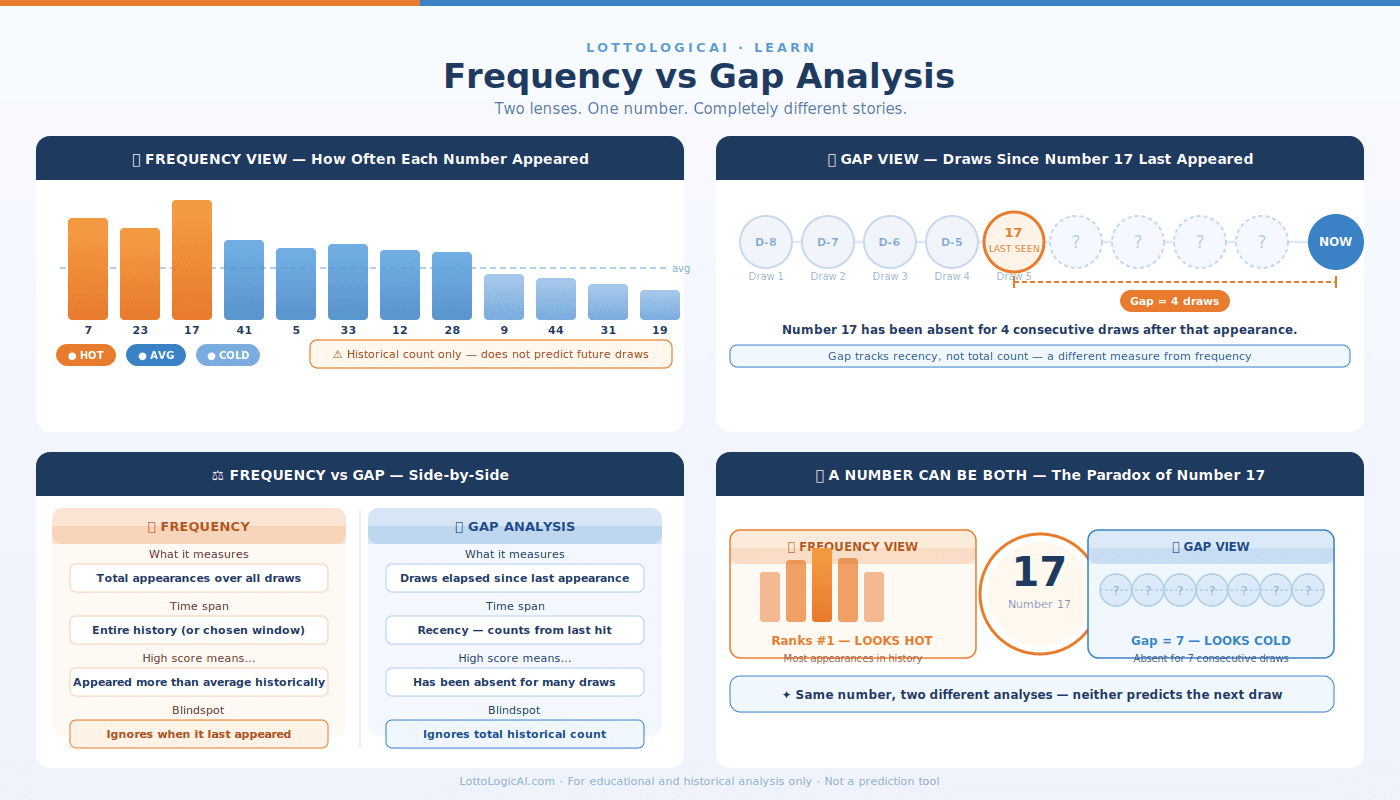
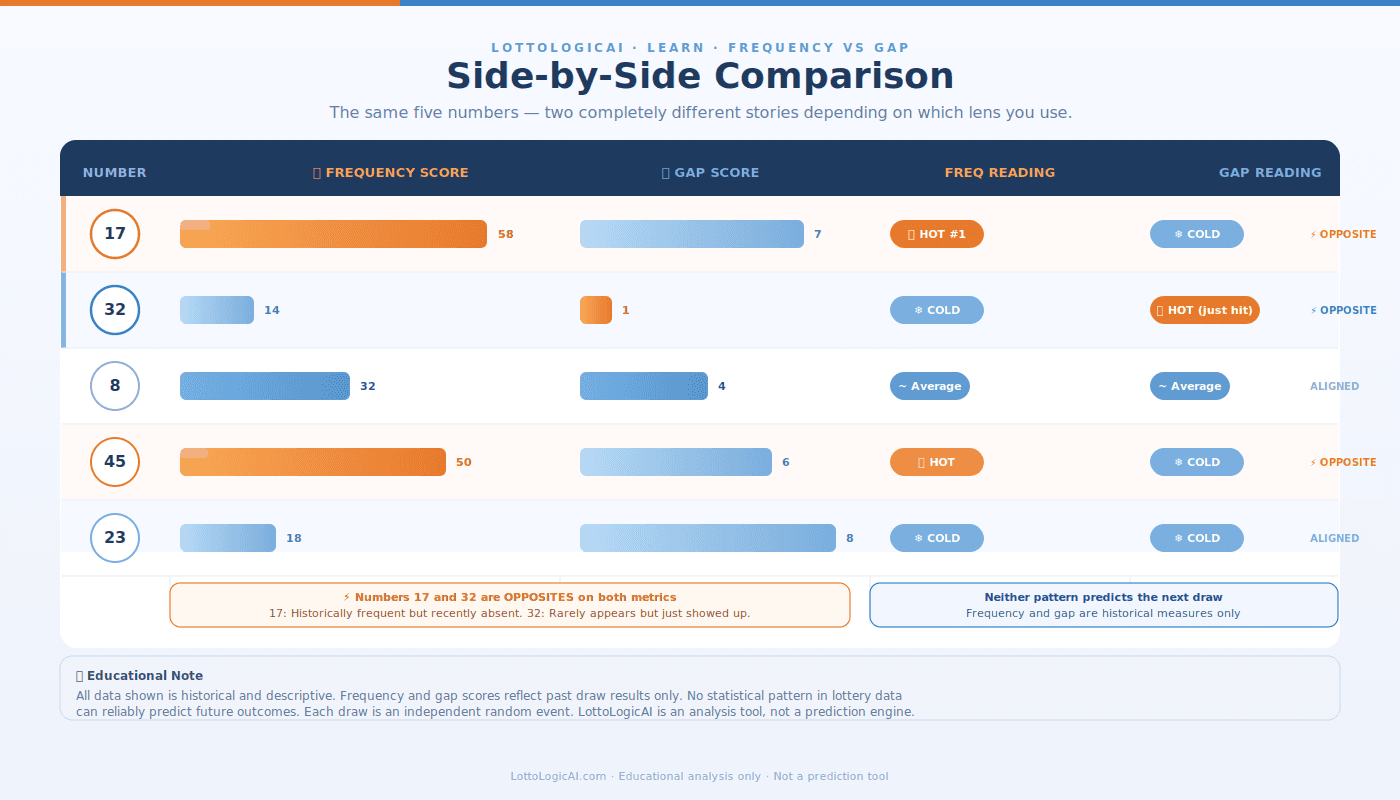
The difference between frequency and gap becomes clearer when you connect both ideas to a real dataset. In a real lottery game, one number can be among the most frequently drawn over time and still have a long current gap if it has not appeared recently.
Another number might have a lower overall historical frequency but still have a gap of 0 because it appeared in the most recent draw. This is why frequency and gap are not interchangeable: one measures total appearances across history, while the other measures recency.
A number can look “hot” when you rank total appearances across a long history, yet still look “cold” in gap terms if it has been absent for many recent draws. Both observations can be true at the same time because they measure different parts of the historical record.
What is frequency analysis?
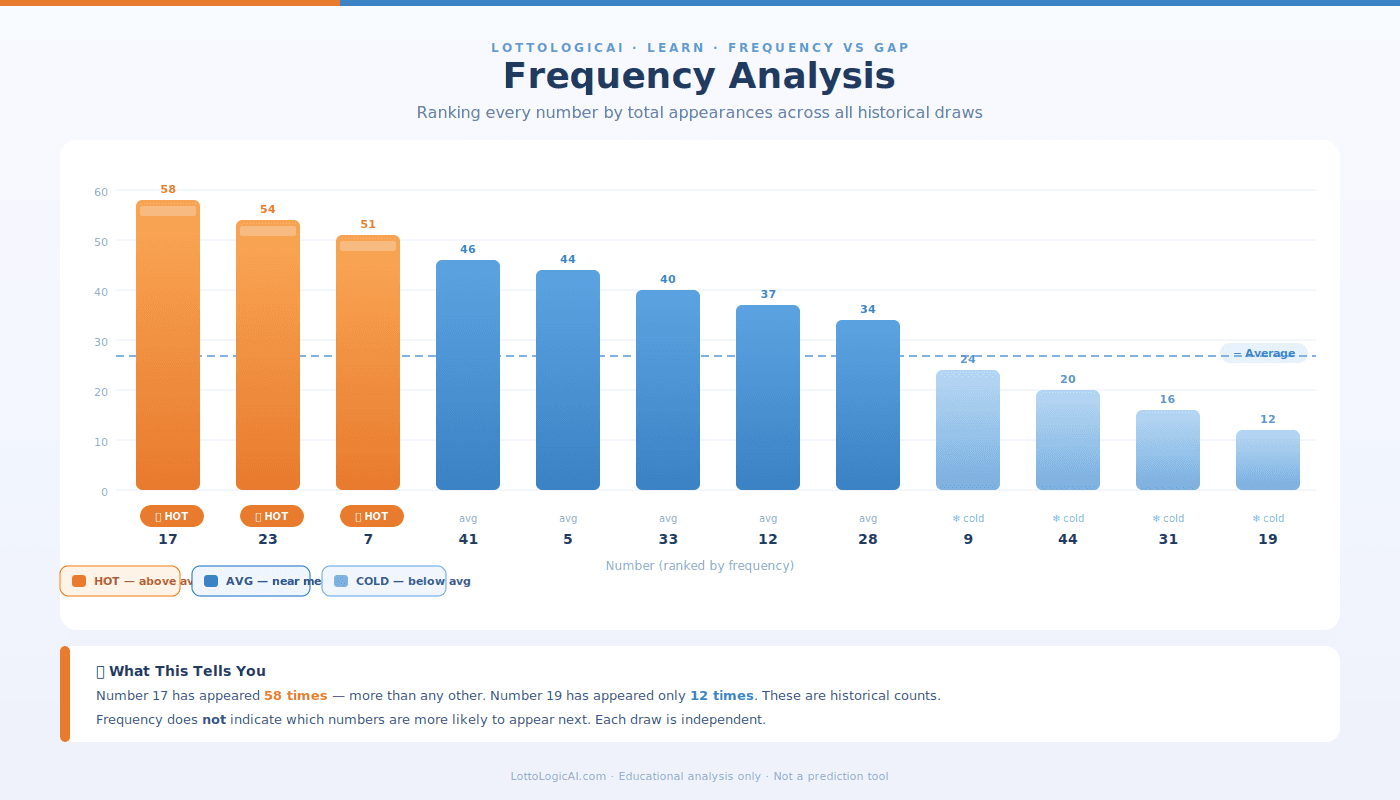
Frequency analysis is one of the simplest and most widely used tools in lottery statistics. It counts how many times each number has been drawn across the entire recorded history of a game.
Numbers that have appeared most often are called hot numbers. Numbers that have appeared least often are called cold numbers. These are descriptive labels only — they describe what has happened in the past, nothing more.
If Powerball has been drawn 1,500 times and number 32 has appeared 95 times, its frequency is 95. The average expected frequency for any number would be around 1,500 × (5/69) ≈ 109 draws. So 32 is below average — a “cold” number by frequency. But in the next draw, 32 still has the same 5-in-69 chance as every other number.
What is gap analysis?
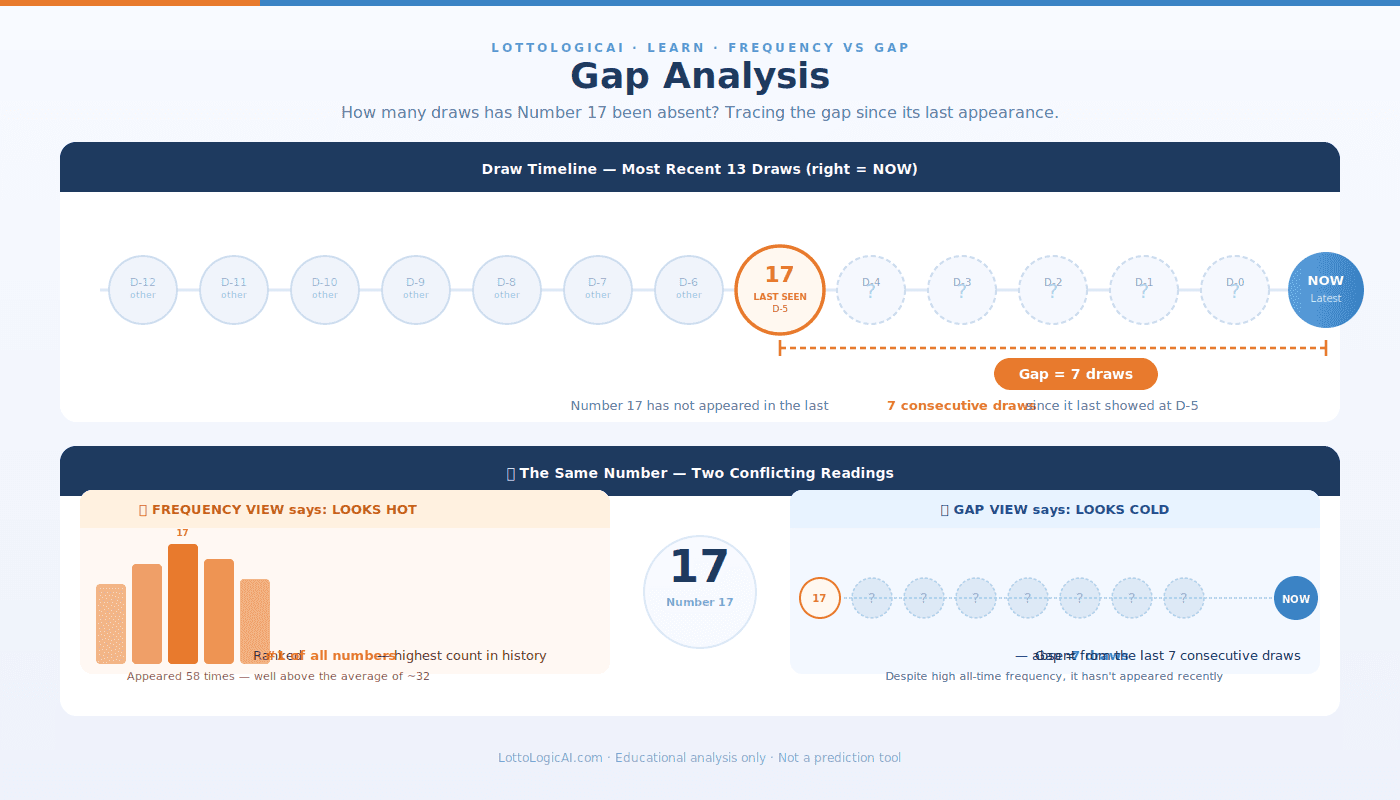
Gap analysis focuses on recency rather than total count. It measures how many draws have passed since a number was last drawn. This is called the number's current gap.
A number with a gap of 0 was drawn in the most recent draw. A number with a gap of 50 has not appeared in the last 50 draws. Gap analysis helps you see which numbers have been absent recently, regardless of their long-term frequency.
Number 17 might have a high overall frequency — drawn 120 times in history. But if it has not appeared in the last 40 draws, its current gap is 40. Gap analysis surfaces this recency information that raw frequency counts hide. Statistically, the gap has no effect on future probability — but it describes an interesting pattern in the data.
The key difference between the two
Frequency analysis looks at the full picture — all draws since the game began. Gap analysis looks at recency — how long it has been since the last appearance. A number can be high-frequency overall but still have a long current gap, or low-frequency overall but have appeared very recently.
| Metric | Frequency analysis | Gap analysis |
|---|---|---|
| What it measures | Total appearances in all history | Draws since last appearance |
| Time window | Entire draw history | Most recent recency state |
| Hot = ? | Drawn most often overall | Appeared very recently |
| Cold = ? | Drawn least often overall | Absent for many draws |
| Best used for | Long-term pattern review | Spotting recent absences |
| Predicts future? | No | No |
What neither analysis can do
This is the most important point: lottery draws are independent random events. Each draw has no memory of what came before. The machine does not know or care that a number has a long gap or low frequency.
Frequency analysis and gap analysis are descriptive tools. They describe patterns in historical data, much like a weather summary can describe what happened last year without telling you exactly what will happen next year.
LottoLogicAI presents both types of analysis purely for educational and research interest. The platform makes no prediction claims and does not suggest that historical data influences future outcomes.
How LottoLogicAI uses both tools together
LottoLogicAI can present frequency and gap information side by side so you can see both dimensions of historical data at once. For a lottery game, that means you can explore:
- Which numbers are hot or cold by total frequency across all draws
- Which numbers have the longest current gaps
- How frequency and gap patterns compare side by side for each number
- Recent draw history so both metrics can be viewed in context
All of this is presented as historical data for educational purposes. The goal is to help users understand the numbers they already follow — not to predict outcomes.
See recent Florida Fantasy 5 draw history and frequency statistics alongside broader historical context.
Open analyzer →Explore public historical stats pages across supported games to compare frequency views and related metrics.
Open analyzer →Frequently asked questions
What is lottery frequency analysis?
Frequency analysis counts how many times each number has been drawn across all historical lottery draws. Numbers drawn most often are called hot numbers; those drawn least often are called cold numbers. It is a descriptive statistical tool — it describes the past but cannot predict the future.
What is gap analysis in lottery statistics?
Gap analysis measures how many draws have passed since a number was last drawn. A large gap means a number has not appeared for many draws. Like frequency analysis, gap analysis is descriptive — a long gap does not make a number more likely to appear next.
What is the difference between frequency and gap analysis?
Frequency analysis looks at the entire draw history to count total appearances. Gap analysis focuses on recency — specifically how long ago a number last appeared. A number can be high-frequency overall but have a long current gap if it has not appeared recently.
Can frequency or gap analysis predict lottery numbers?
No. Lottery draws are independent random events — each draw has no memory of previous draws. Neither frequency nor gap analysis can predict future results. Both are useful for understanding historical patterns only.
- Lottery FrequencyLearn how historical appearance counts are measured and interpreted.
- Lottery GapUnderstand the recency side of analysis and what absence really means.
- Hot and Cold NumbersSee how windowed frequency labels relate to both frequency and gap.
- What “Overdue” Means in Lottery HistorySee how “overdue” language overlaps with gap-based thinking.
- Lottery Stats HubBrowse public historical stats pages across supported games.
- Mega Millions StatisticsExplore a public stats page with main-number and Mega Ball frequency.
- Powerball StatisticsCompare another multi-pool public stats page built from real historical data.
- Florida Fantasy 5 StatisticsCompare a Pick-5 style public game page using the same descriptive framing.
Continue with Public Stats or Create an Account
Browse public historical stats pages or create an account to access more LottoLogicAI tools built around descriptive-only analysis.