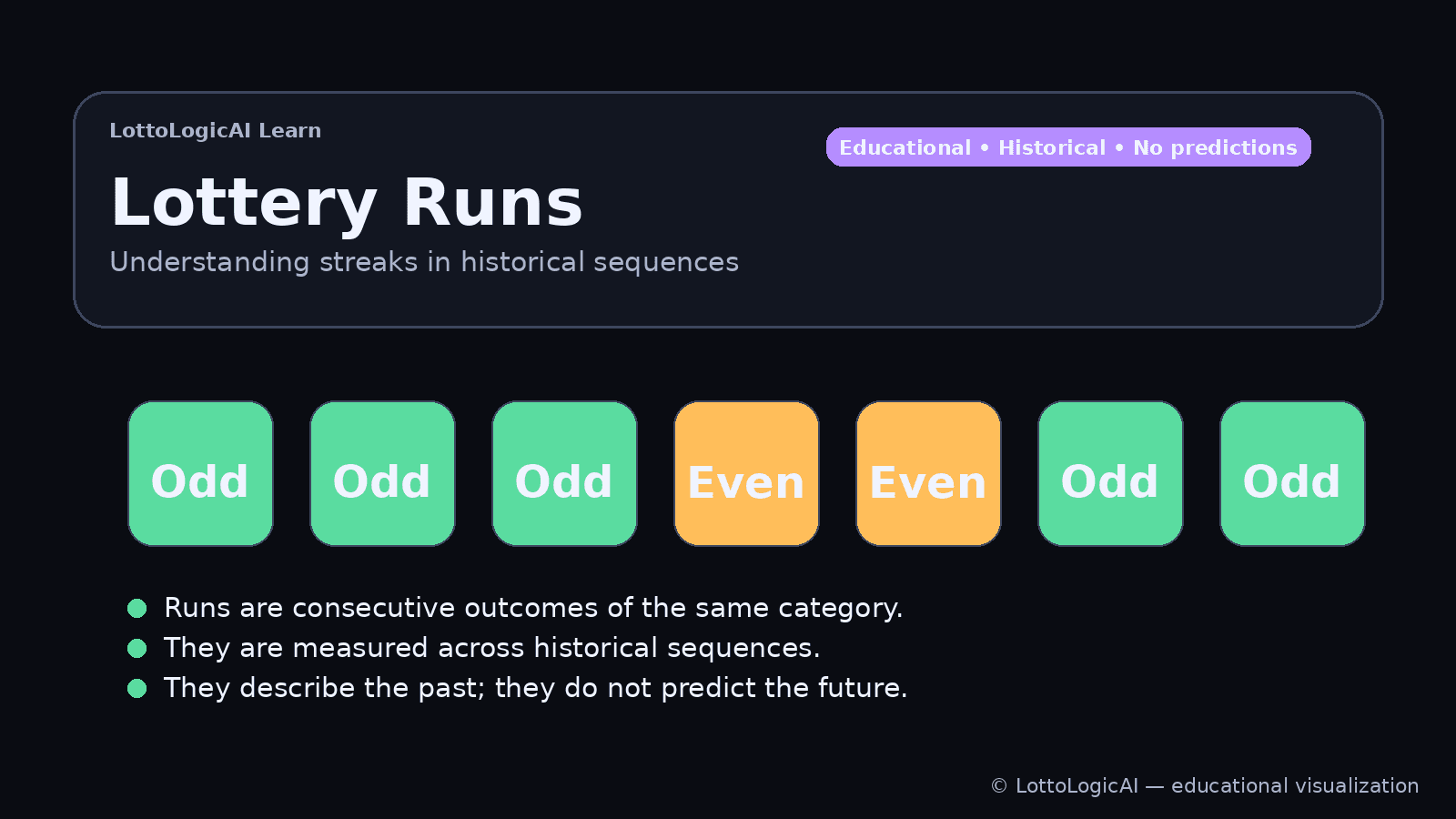
What is a lottery run?
A run is a sequence of the same label appearing consecutively when you look across a timeline of draws. The label can be parity (odd vs even), low/high bands, or another descriptive grouping used for educational analysis. When the label changes, one run ends and a new run begins.
If draws 1, 2, and 3 all produce odd-heavy results, that is a run of length 3. Draw 4 producing even-heavy results ends that run and starts a new one. Both the run and its ending are historical descriptions — neither tells you anything about draw 5.
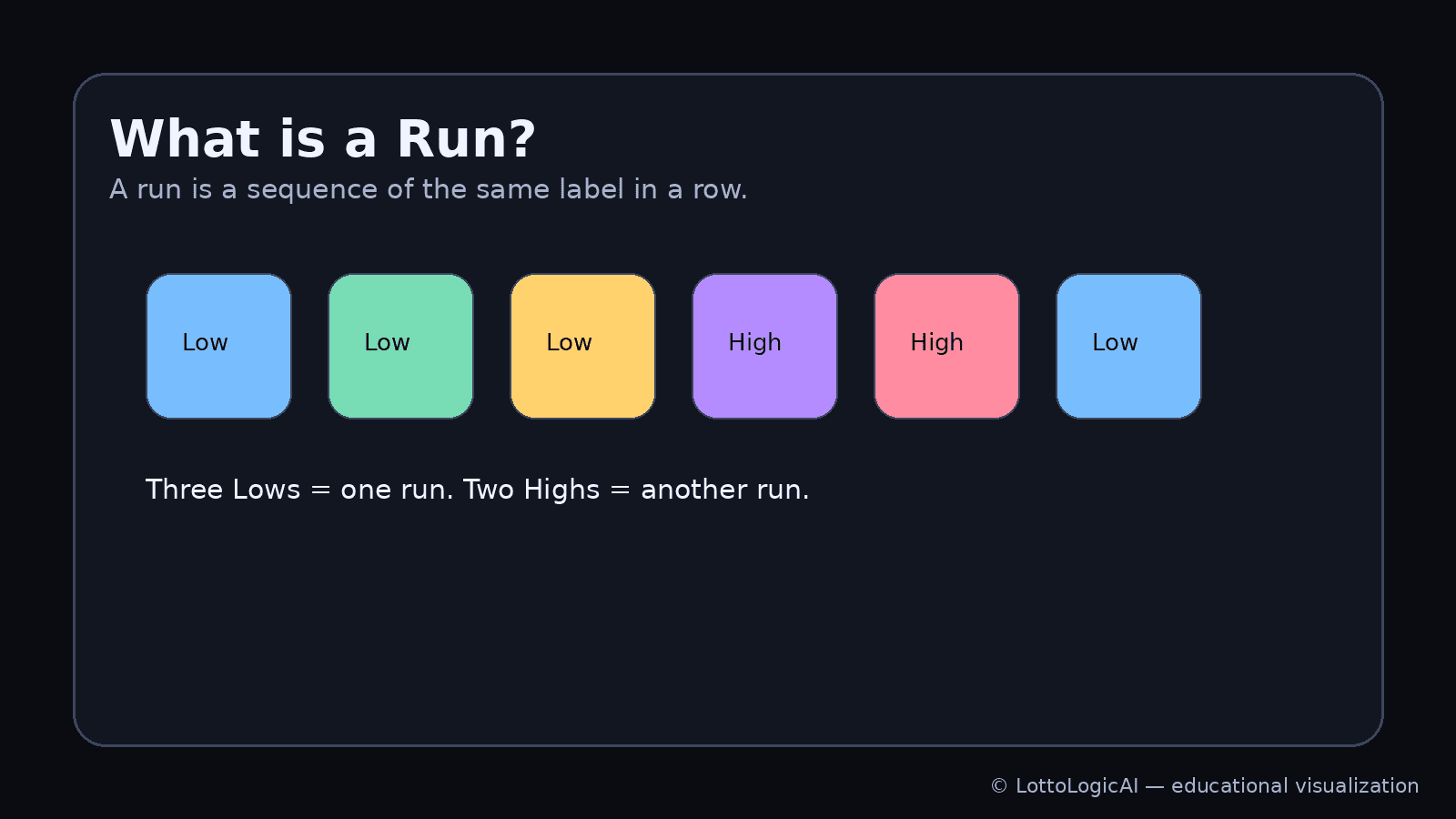
Runs vs streaks vs hot and cold
People often say streak informally. In practice, a streak is simply a long run. Run is the counting concept; streak is a common nickname for an unusually long run.
This differs from hot and cold numbers, which usually refers to frequency of individual numbers over a window. Runs focus on sequential repetition of a category across time, not individual number counts.
Run analysis is also distinct from gap analysis. A gap measures how many draws have passed since a specific number last appeared. A run measures how many consecutive draws shared the same category label. You can have a long gap inside a short run, or a short gap inside a long run — they are independent views.
Why runs happen naturally in randomness
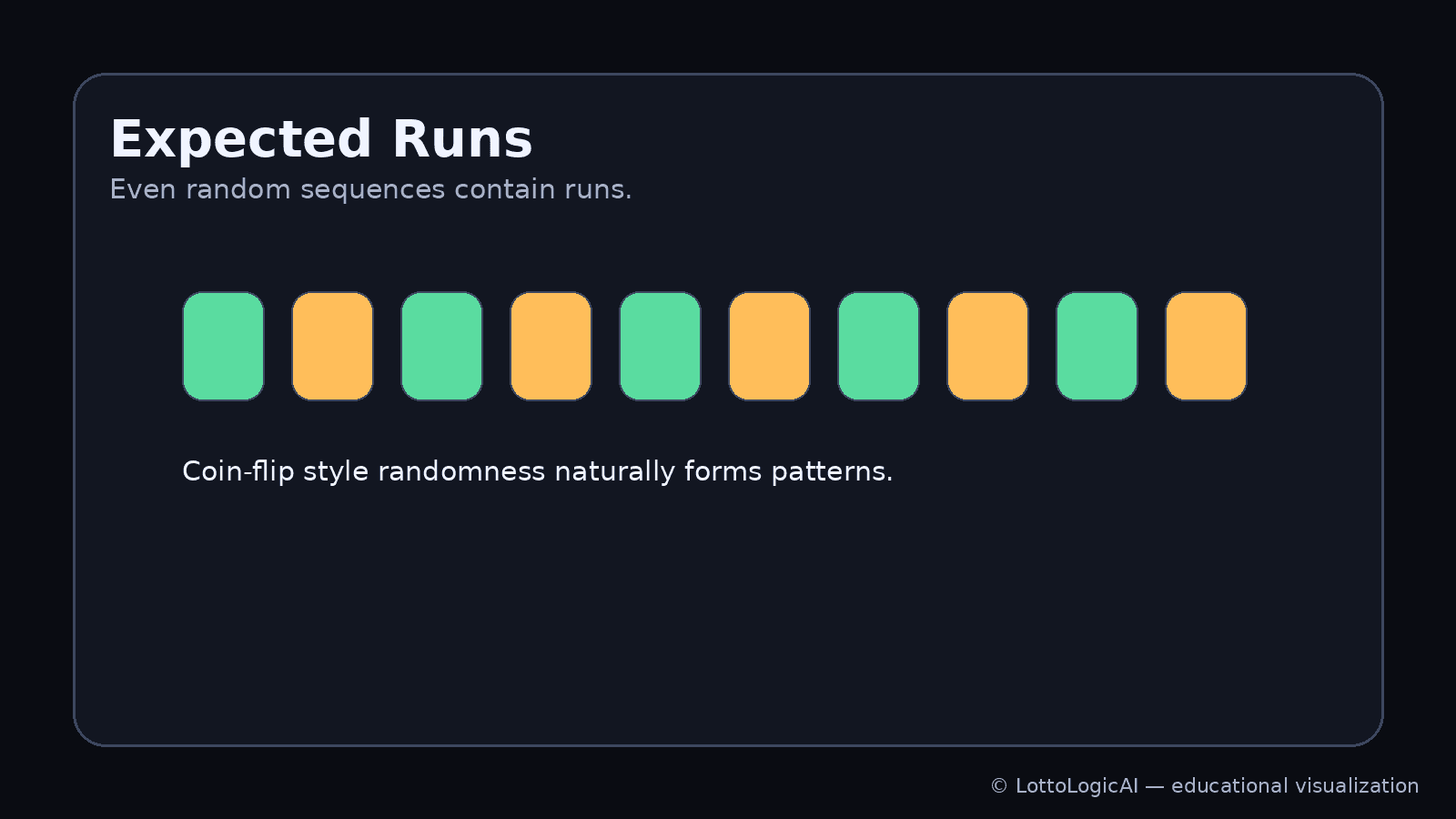
Runs appear naturally in randomness. Even in a purely random coin-flip style sequence, you will regularly see short streaks simply because repetition happens by chance. In small samples, patterns can look meaningful — but that is often normal variation in a short window, not a signal.
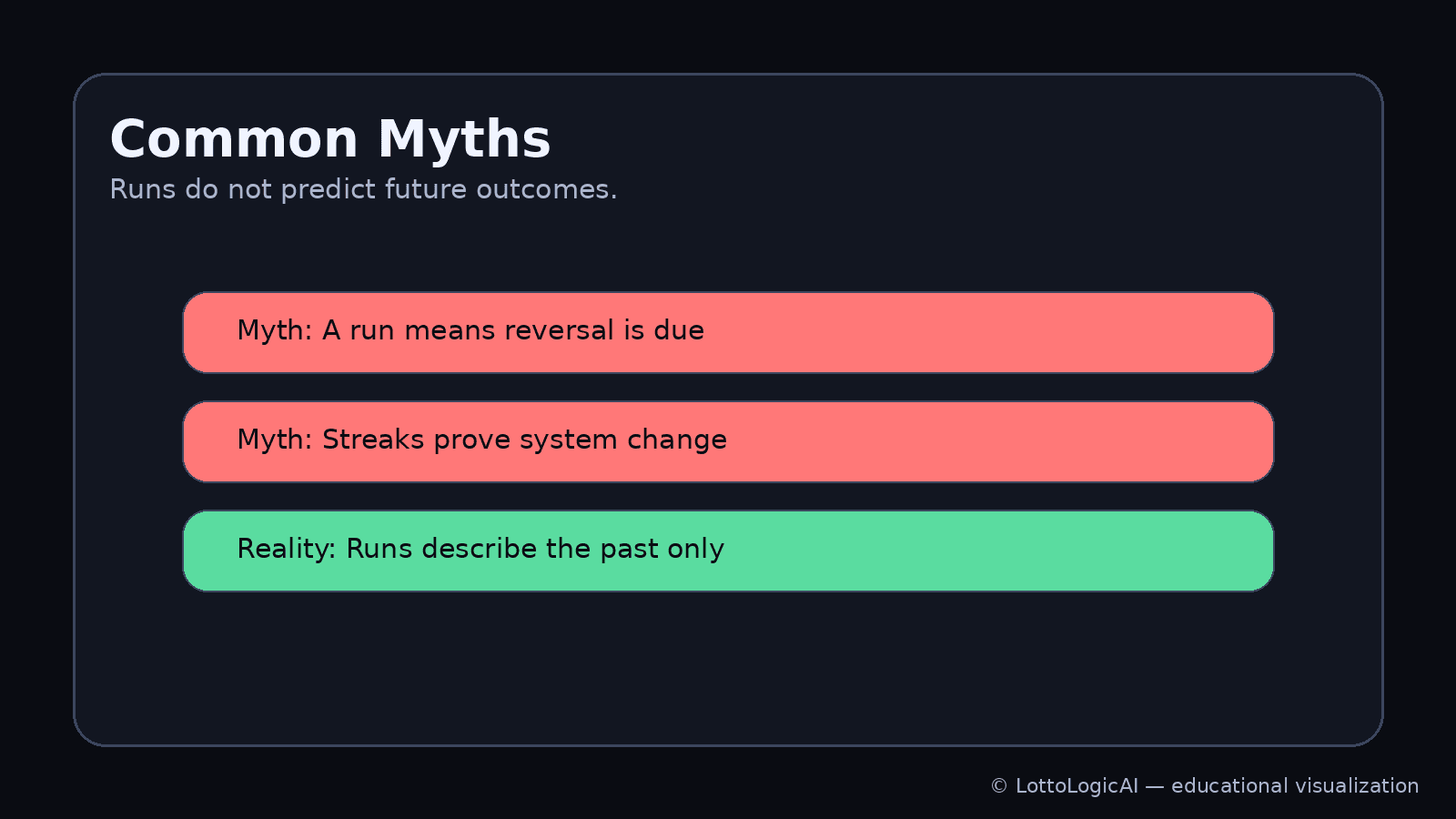
This is the same principle that applies to overdue numbers and the Gambler's Fallacy: seeing a run does not mean a reversal is coming. The process has no memory of prior results.
Do lottery runs mean a reversal is due?
No. Because runs are easy to see, they are often over-interpreted. A common fallacy is thinking a reversal is due after a long streak. Lottery draws are independent events. Runs in history do not create obligations for what happens next.
This applies whether the run is parity-based (too many odd-heavy draws), gap-based (a number that has been absent for many draws), or any other category. The historical pattern describes what already happened — it does not constrain the next draw.
How runs connect to gap and parity analysis
Run analysis works best as one view among several. Combining run data with gap analysis gives you a fuller picture of historical sequence behavior: you can see both how long categories repeated and how long individual numbers stayed absent.
Similarly, combining runs with parity analysis lets you see whether odd-heavy or even-heavy draws tend to cluster in runs within your dataset. These are historical observations — not forecasting tools.
Understand what gap measures and how it differs from run analysis as a historical descriptor.
Open analyzer →See how odd/even composition across draws connects to run patterns.
Open analyzer →How to read runs correctly
- Use runs to describe how categories repeated in history.
- Expect short and medium streaks to appear naturally.
- Compare different windows for context before over-reading a pattern.
- Avoid treating a visible run as a signal of reversal or continuation.
Runs work best as one descriptive lens alongside other historical views such as parity, gap, and broader sequence analysis.
Where to see this in LottoLogicAI
Run-related history connects naturally with LottoLogicAI's public stats and Learn surfaces. These pages help place visible streaks into broader historical context.
Use a public stats page to connect sequence ideas to real historical lottery data.
Open analyzer →Compare another historical stats page built from real draws.
Open analyzer →Frequently asked questions about lottery runs
What is a lottery run?
A lottery run is a streak of the same category appearing consecutively across a historical sequence of draws. For example, three draws in a row where the parity is odd-heavy would be a run of length three.
Do lottery runs predict the next draw?
No. Runs describe what happened in a historical sequence. They do not predict future outcomes. Each draw is an independent random event.
Are lottery streaks unusual?
No. Short and medium streaks occur naturally in random sequences. Seeing a run does not mean the system is correcting or that a reversal is due.
What is the difference between runs and hot or cold numbers?
Runs focus on consecutive repetition of a category across time. Hot and cold labels usually refer to frequency within a selected recent window. Both are descriptive historical views.
Is there a lottery gap between runs?
Gap analysis and run analysis are related but different views. Gap measures how many draws have passed since a number last appeared. Runs measure how many consecutive draws shared the same category label. Both are historical descriptors only.
- Lottery GapSee how runs differ from time-since-last-appearance analysis.
- Hot and Cold NumbersCompare sequential streaks with windowed frequency labels.
- Lottery ParityLearn another descriptive lens for tracking historical patterns.
- What “Overdue” Means in Lottery HistoryUnderstand why visible streaks do not create a future obligation.
- Lottery Stats HubBrowse public historical stats pages across supported games.
- Mega Millions StatsExplore a public multi-pool stats page with main-number and Mega Ball frequency.
- Powerball StatsCompare another public multi-pool stats page for a major lottery game.
- Florida Fantasy 5 StatsCompare another real stats page using historical draw data.
Continue with Public Stats or Create an Account
Browse public lottery stats pages or create an account to explore more historical analysis tools inside LottoLogicAI.