
What is position?
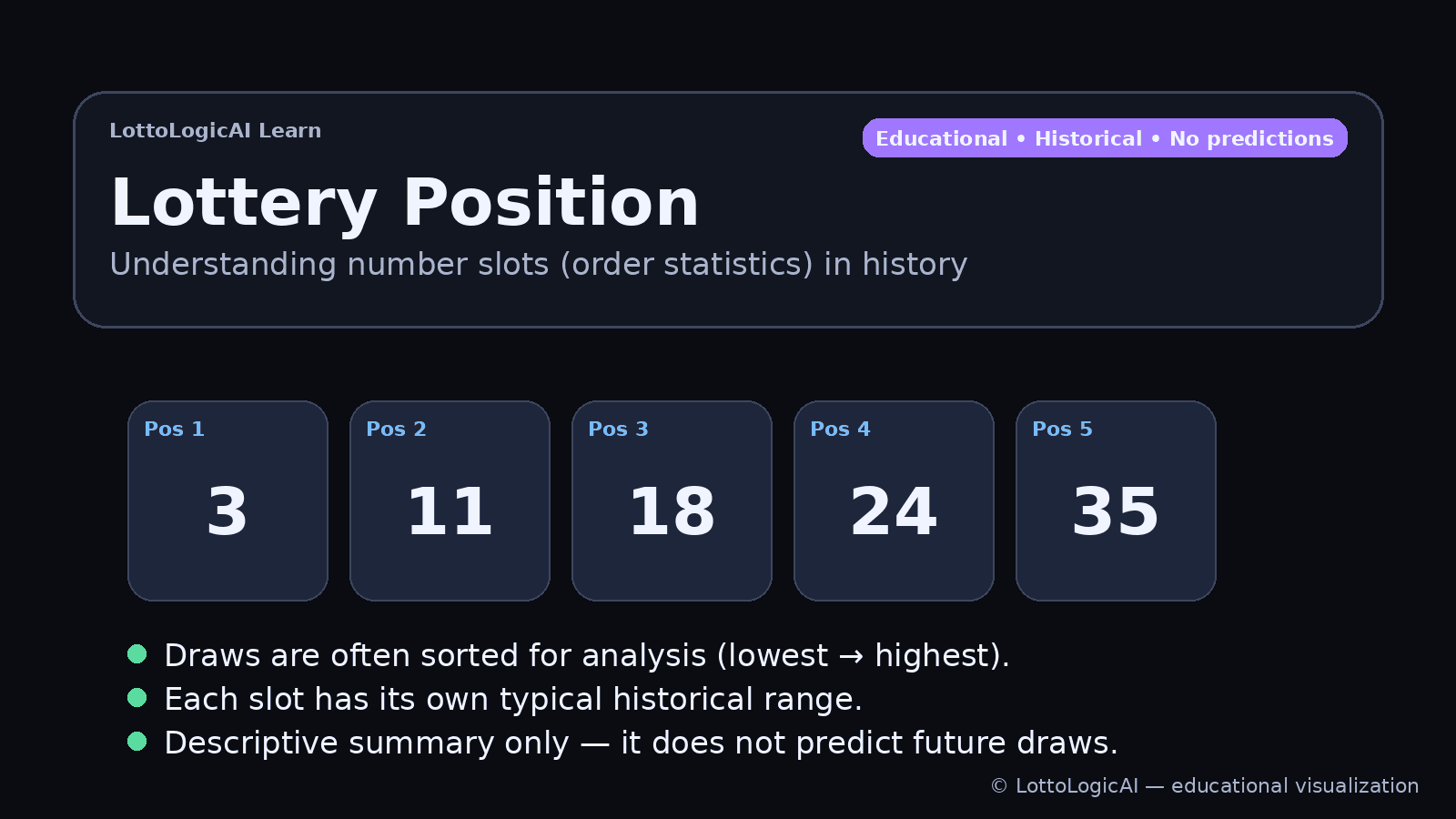
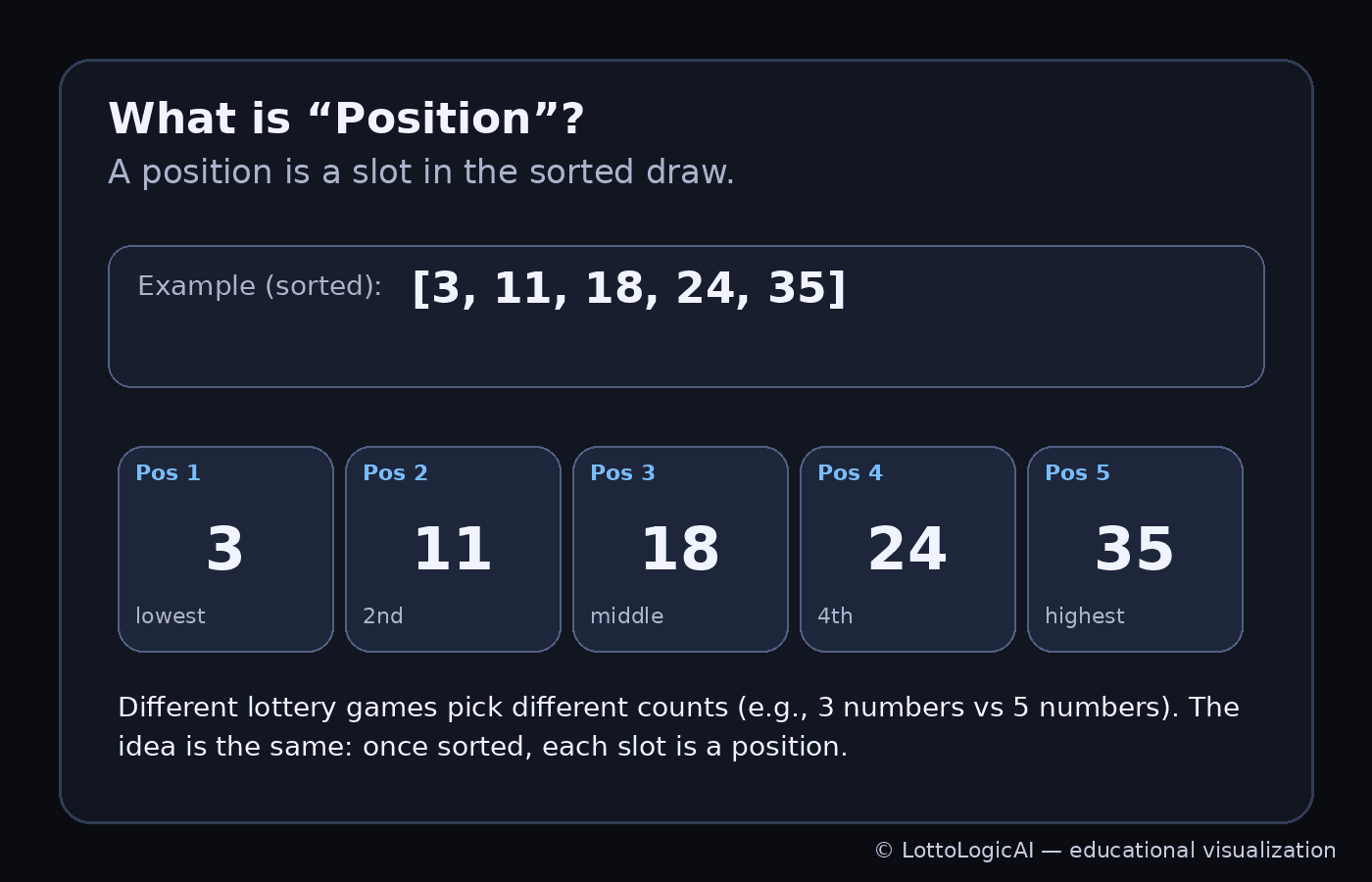
When analysts talk about position, they usually mean the slot in the sorted draw. For a 5-number draw, you can label the slots from position 1 (lowest number) through position 5 (highest number).
Sorted draw: 3 — 11 — 18 — 24 — 35. Position 1 = 3, position 5 = 35. Different games use different counts, but the idea is the same: once sorted, each slot becomes a position.
Position is not an intrinsic property of a number — it is a label that depends entirely on what else was drawn alongside it. The number 18 could be in position 1 of one draw and position 3 of another.
Slot distributions
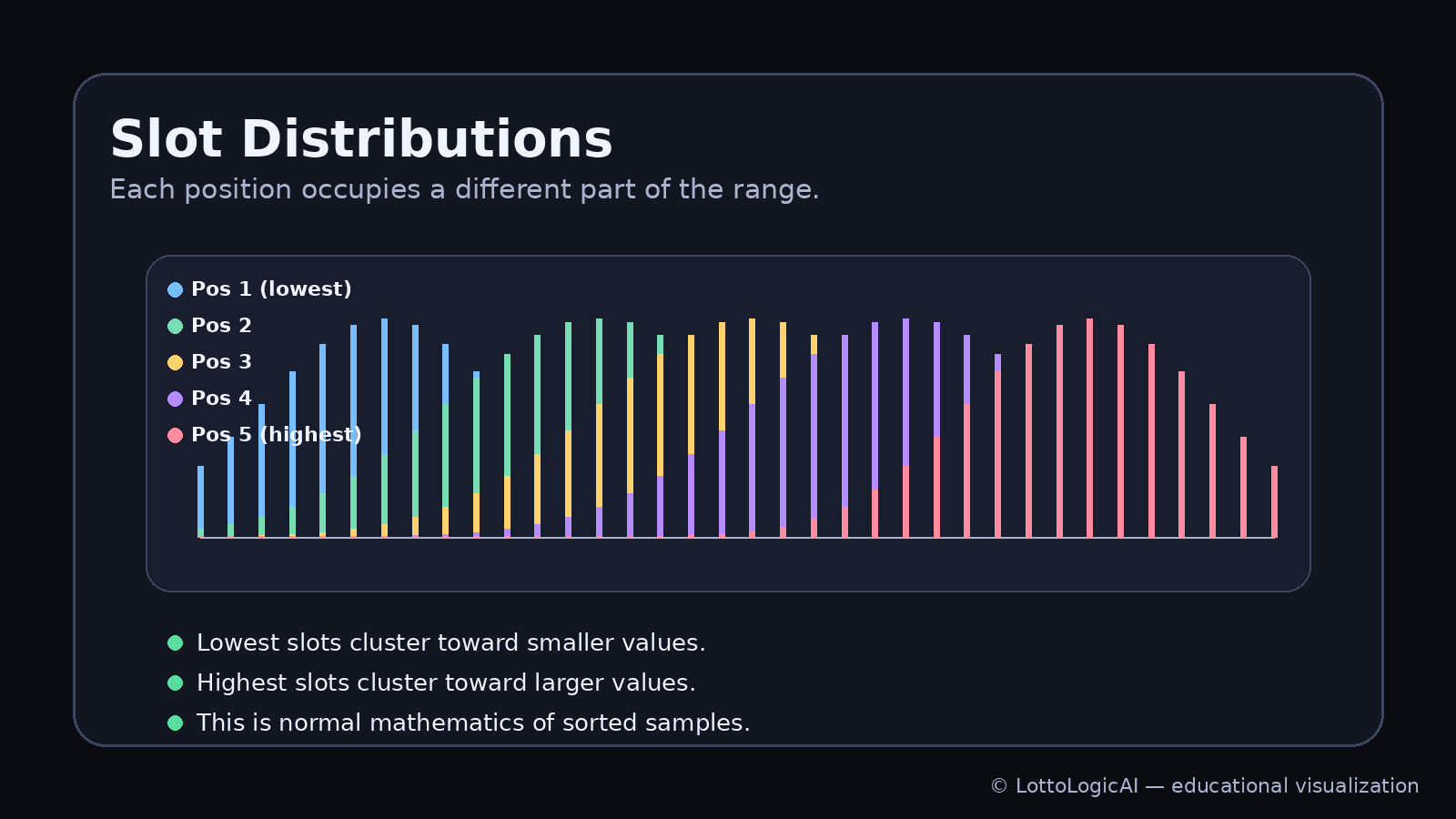
If you track each slot across a large historical dataset, you will usually see that positions occupy different parts of the number range. The lowest slot clusters lower, while the highest slot clusters higher.
This is the normal mathematics of sorted samples, often called order statistics. It describes what tends to happen in sorted historical data. It does not imply any advantage or predict which specific numbers will occupy which slot next.
This is also why questions like “do low numbers come up more?” can be misleading. Low numbers appear in position 1 by definition — that is what sorted means. But they are not drawn more frequently than high numbers overall.
Range, spread, and how they connect to position
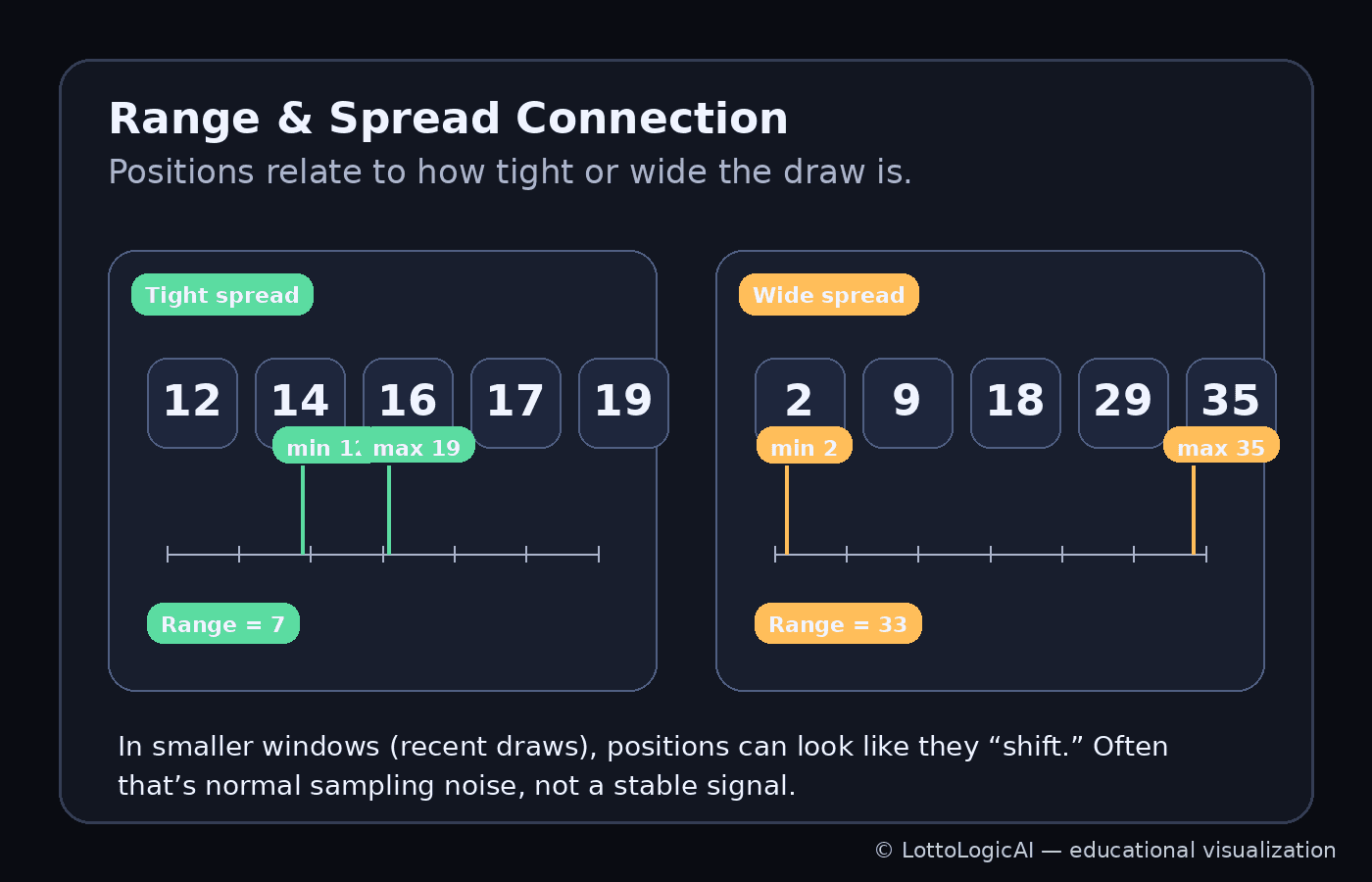
Position also connects to a draw's spread: how far apart the smallest and largest numbers are. A tight spread pulls positions closer together, while a wide spread pushes the lowest and highest positions farther apart.
This is closely related to sum range analysis: a draw with a wide position spread will often have a higher total sum, while a tight spread will tend toward a lower sum. Both are descriptive historical properties — neither predicts the next draw.
If you analyze smaller windows, the typical ranges of positions can appear to shift. Often that is normal sampling noise — a descriptive artifact, not a stable signal.
Common position myths
Because position charts can look structured, it is common to attach meaning that is not supported. Position is simply a way to summarize how sorted draws behaved in the past.
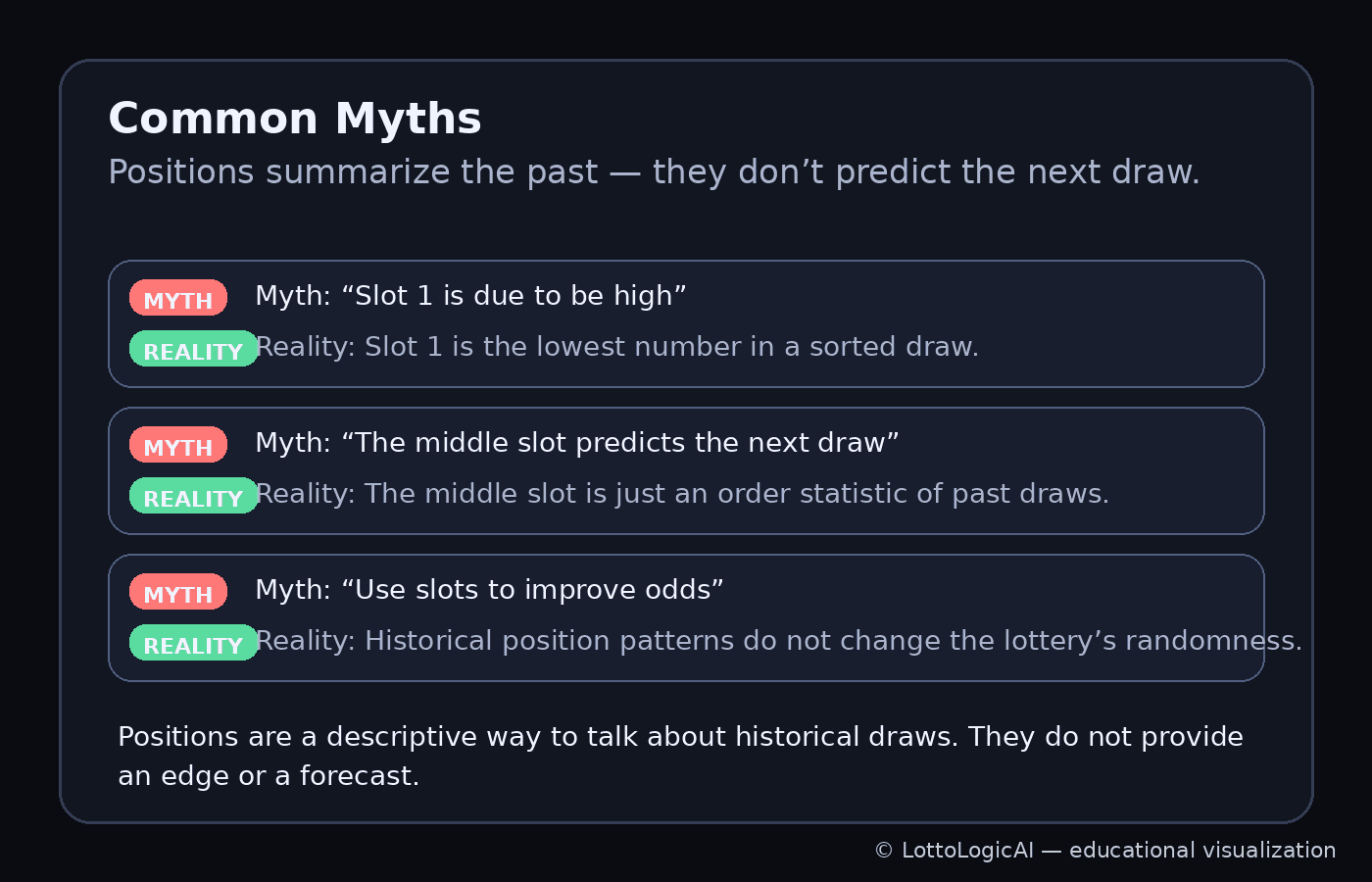
- Myth: Slot 1 tends to be low so you should pick a low number.Reality: Slot 1 is always the lowest drawn number by definition. That tells you nothing about which specific number will be lowest next.
- Myth: The middle slot predicts the median of the next draw.Reality: Position 3 of past draws describes past medians. It does not constrain future draws.
- Myth: Use slot ranges to improve odds.Reality: Position summarizes the past and does not predict future draws or provide an edge.
Position, Powerball, and most commonly drawn numbers
Searches like “most common winning Powerball numbers” or “most popular numbers for Powerball lotto” are often looking for frequency data — which numbers have appeared most in historical Powerball draws. Position analysis is adjacent to this: it shows which parts of the number range tend to appear in each sorted slot, but it is not the same as a raw frequency count.
Both frequency and position describe past data only. A number that has appeared often in position 2 historically is not more likely to appear in position 2 next draw. Each draw is independent.
Explore real public Powerball data including historical frequency counts and draw records.
Open analyzer →How to read position correctly
- Use position to summarize sorted historical draws.
- Expect different slots to occupy different ranges.
- Compare short windows with longer history for context.
- Avoid reading slot behavior as predictive or strategic.
Position works best as one descriptive lens alongside other historical views such as frequency, parity, and sum range.
Where to see this in LottoLogicAI
Position-related historical summaries appear across LottoLogicAI's public stats surfaces. These pages connect the concept to real historical data and real lottery records.
Browse a public stats page based on real historical draw data.
Open analyzer →Compare another Pick-5 style public stats page built from historical results.
Open analyzer →Frequently asked questions about lottery position
What is position in lottery analysis?
Position refers to the slot a number occupies after a draw is sorted from lowest to highest. The lowest number sits in position 1, the next in position 2, and so on. Position is a descriptive historical summary and does not predict future draws.
Do low numbers come up more in lottery draws?
Low numbers naturally occupy the lowest slot in a sorted draw, but that does not mean they appear more often overall. Each number has the same probability of being drawn. Position 1 will always be the lowest number drawn — it is a sorting artifact, not a frequency advantage.
Why do different lottery positions show different number ranges?
Because draws are sorted, the lowest slot is mathematically constrained to be low and the highest slot to be high. This is a property of sorted samples — called order statistics — not a signal about future draws.
Can position analysis predict the next lottery draw?
No. Position analysis is descriptive only. It summarizes the historical distribution of numbers across sorted slots and does not predict future outcomes.
What are the most popular numbers for Powerball?
Frequency counts show which Powerball numbers have appeared most often in historical draws, but these counts describe the past only. No number is more likely than another in any future draw. LottoLogicAI presents these as historical summaries without prediction claims.
- Lottery FrequencyLearn how appearance counts differ from slot-based historical summaries.
- Lottery GapCompare position analysis with time-since-last-appearance analysis.
- Lottery ParitySee another descriptive lens for understanding historical draw composition.
- Lottery SumSee how total draw values connect to position spread and range.
- Lottery Stats HubBrowse public historical stats pages across supported games.
- Powerball StatisticsSee a real public Powerball stats page built from historical draw data.
- Florida Fantasy 5 StatsExplore a Pick-5 style stats page built from historical draw data.
- California Fantasy 5 StatsCompare another public game page using the same educational framing.
Continue with Public Stats or Create an Account
Browse public lottery stats pages or create an account to explore more historical analysis tools inside LottoLogicAI.