
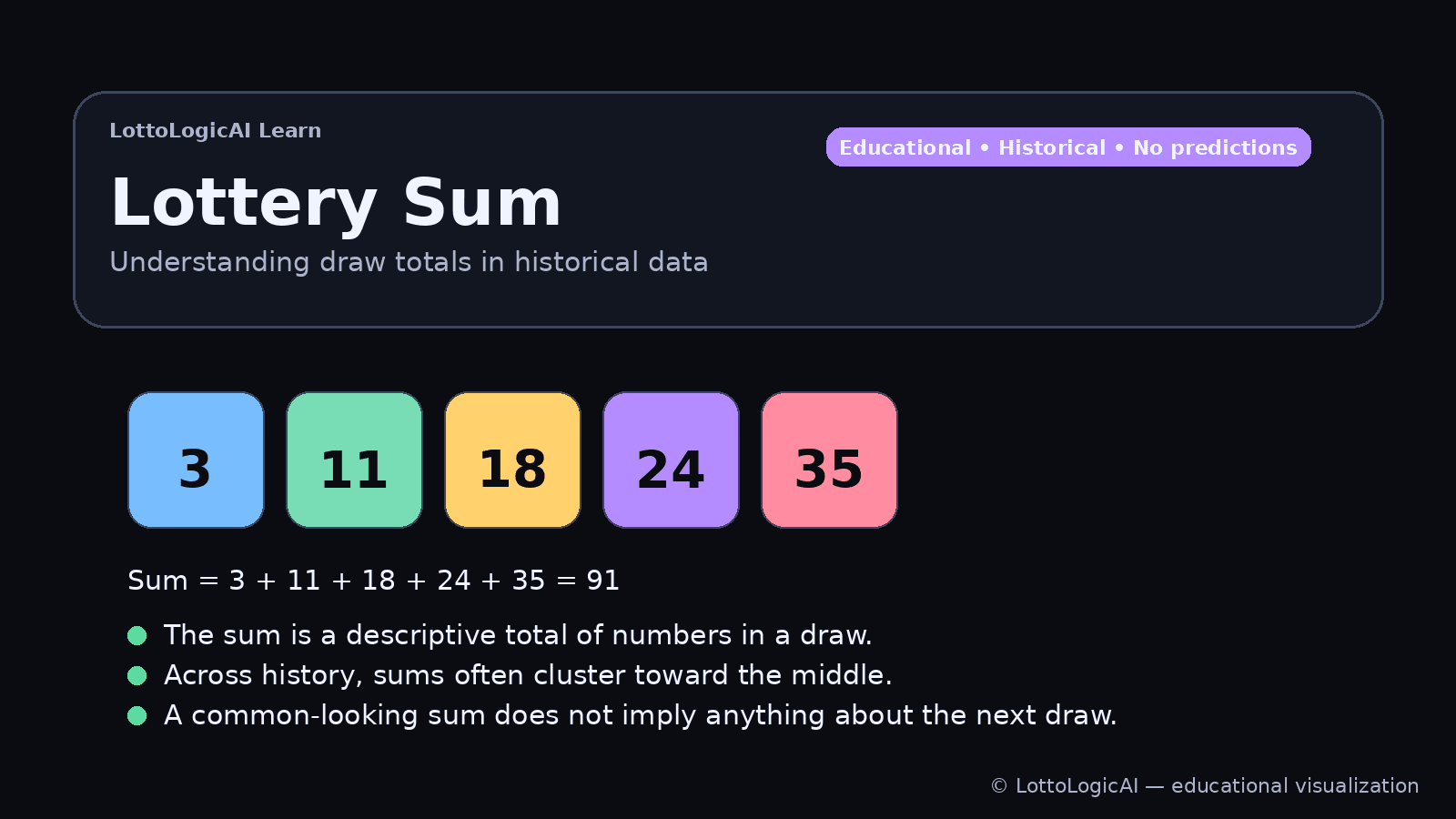
What is a lottery sum?
A lottery sum is calculated by adding every number in a draw. Nothing more, nothing less.
Draw: 5 — 12 — 19 — 27 — 34. Sum = 5 + 12 + 19 + 27 + 34 = 97. That single total becomes one data point in your historical record.
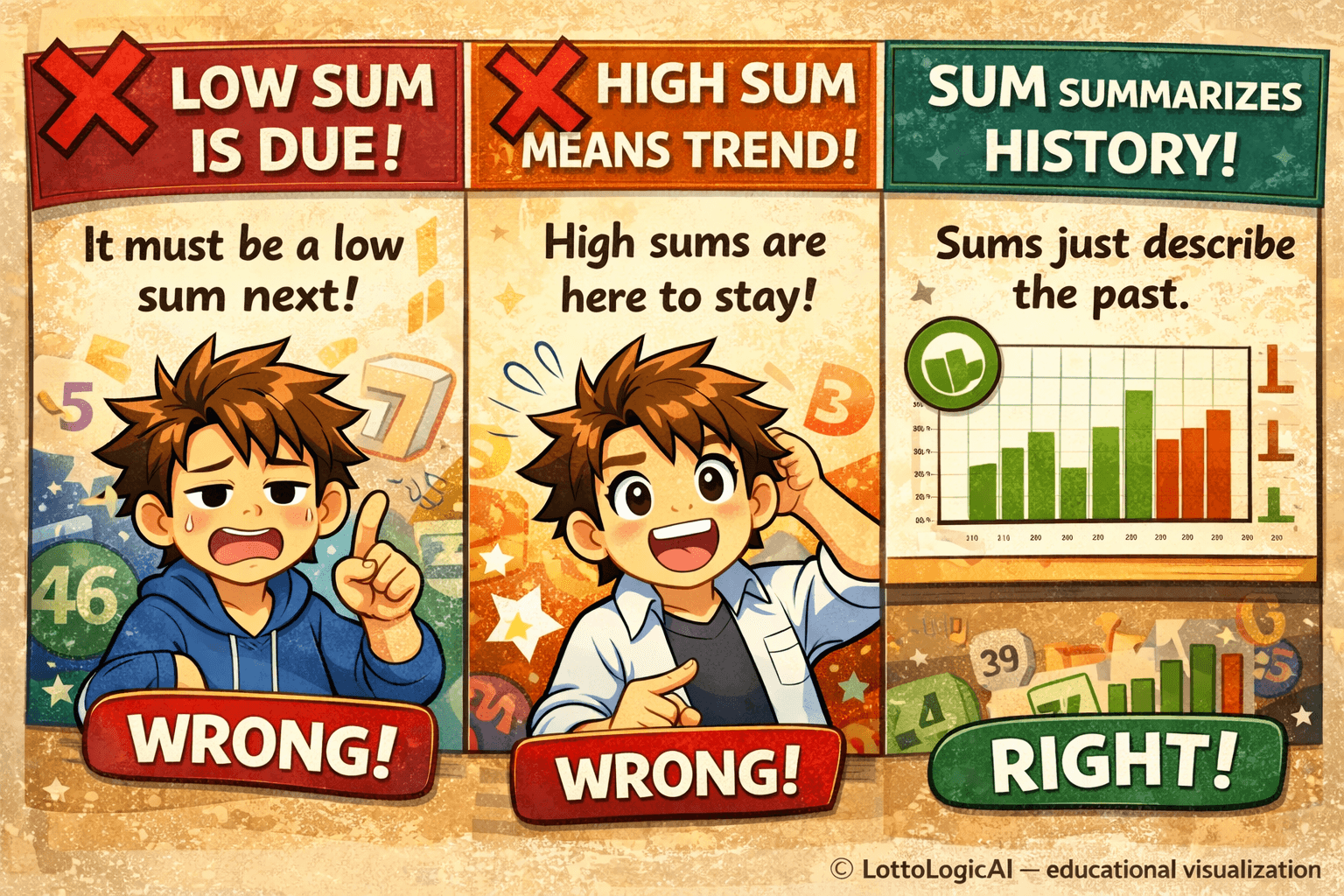
Sums do not represent skill, momentum, or luck. They are simply descriptive math applied to past draws. The sum of a draw tells you something about its composition — it tells you nothing about the next draw.
Why sums cluster into ranges
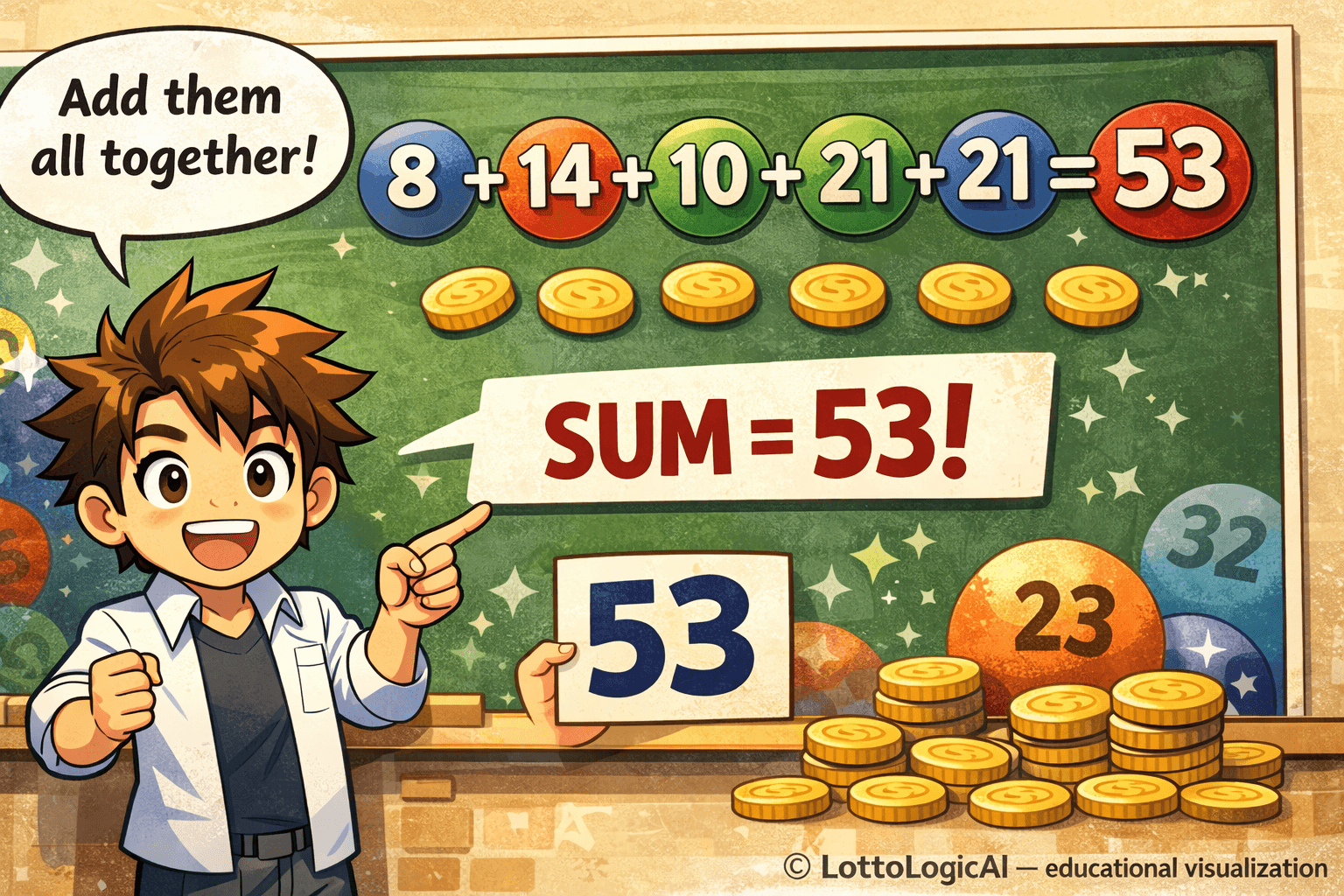
Because lottery numbers come from a fixed range, most totals naturally fall near the middle. Extremely low or extremely high sums are mathematically rarer, while mid-range totals are more common.
This is not a predictive pattern. It is a normal property of how combinations are distributed across a fixed pool. The combinations that produce extreme sums — all low numbers or all high numbers — are simply fewer in count than those that produce middle totals.
So when researchers ask “is there a normal sum range for lottery drawings?” — the answer is yes, in a descriptive sense. Middle ranges appear more often in history. But that history does not constrain future draws.
How sum relates to gap analysis
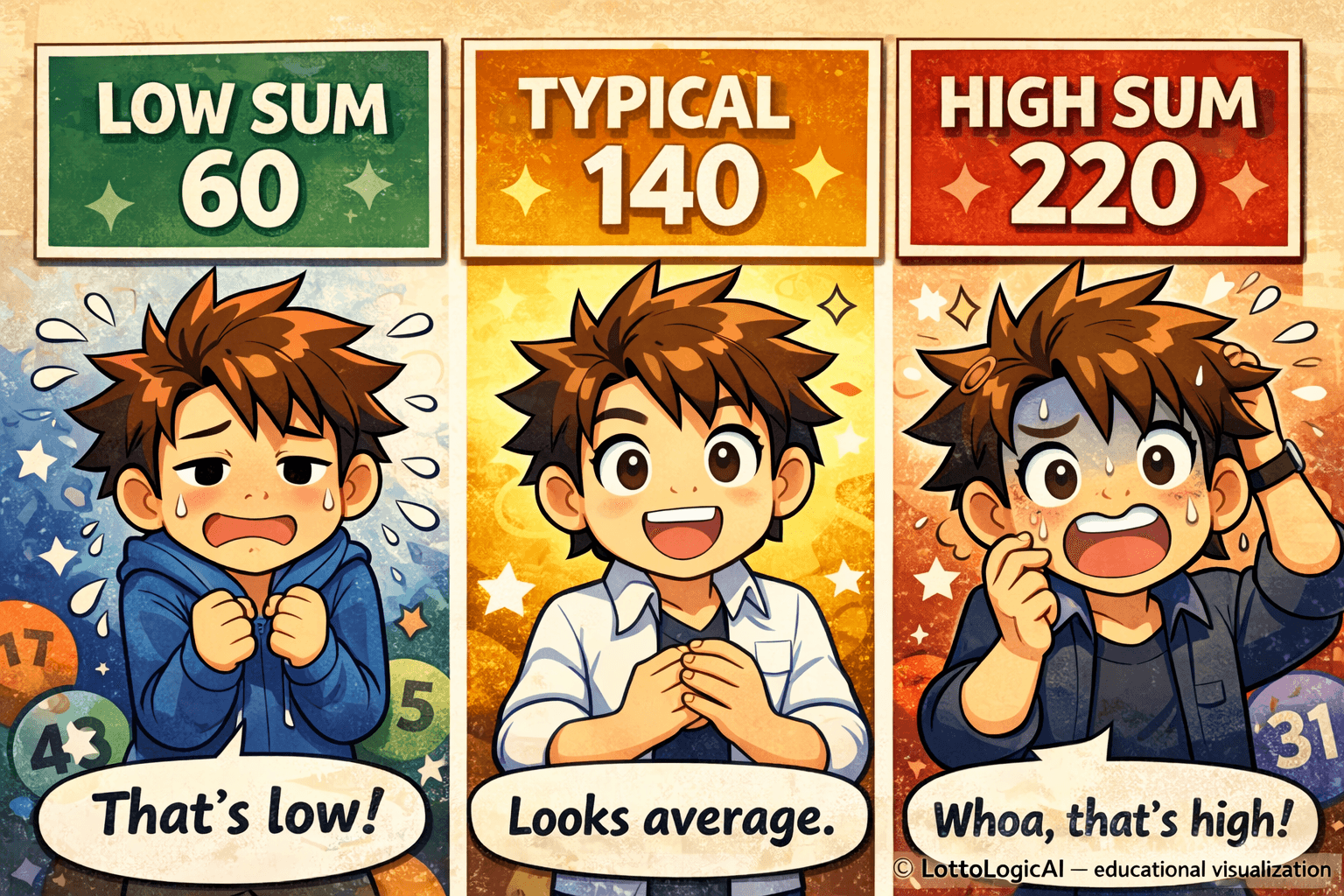
Sum and gap analysis are two different historical views of the same dataset. Sum looks at the total value of each draw. Gap looks at how long each number has been absent between appearances. Both are descriptive tools — neither predicts future results.
Some researchers combine sum and gap views to get a richer descriptive picture: for example, looking at whether high-sum draws cluster in certain time windows, or whether long-gap numbers tend to appear in lower- or higher-sum draws. These are historical observations only.
Understand what gap measures and how it differs from sum as a historical descriptor.
Open analyzer →Why sums change with different windows
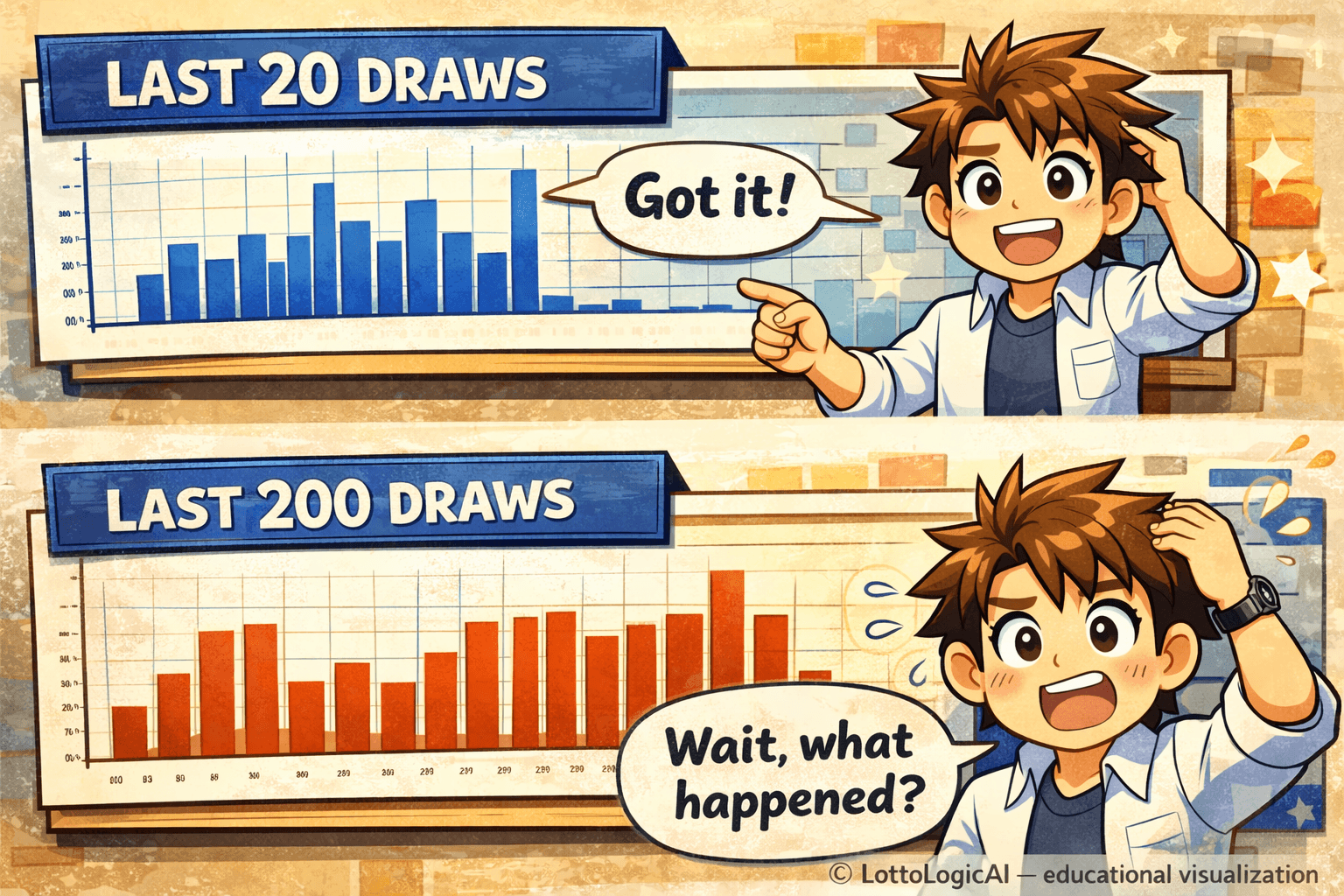
When you calculate sums over different historical windows — such as the last 20 draws versus the last 200 — the average and the distribution can shift. Short windows exaggerate randomness. Longer windows smooth it out.
This does not indicate cycles or trends. It mainly reflects sample size effects inside a historical window. The same effect applies to hot and cold number labels — short windows can look dramatic, but longer windows tend to show that the variation is ordinary randomness.
Common myths about lottery sums
Sum analysis is frequently misused. The most common errors involve treating historical totals as signals about what comes next.
- Myth: A low sum is due after several high-sum draws.Reality: Each draw is independent. Past totals do not create an obligation for the next draw.
- Myth: A run of high sums means a trend is forming.Reality: Runs of similar totals are normal in random data. They are not signals of a cycle.
- Myth: Choosing numbers that produce a mid-range sum improves odds.Reality: Every combination has the same probability of being drawn regardless of its sum.
How to read sum correctly
- Use sum to describe total draw values in history.
- Expect most totals to cluster near the middle of the range.
- Compare short windows with longer history for context.
- Avoid treating low or high totals as signals about the next draw.
Sum works best as one descriptive lens alongside other historical views such as parity, position, and frequency.
Where to see this in LottoLogicAI
Sum-related historical summaries appear across LottoLogicAI's public stats surfaces. These pages connect the concept to real historical data and real lottery records.
Browse a public stats page based on real historical draw data.
Open analyzer →Compare another Pick-5 style public stats page built from historical results.
Open analyzer →Frequently asked questions about lottery sum
What is a lottery sum?
A lottery sum is the total of all numbers in a single draw. If a draw produces 5, 12, 19, 27, and 34, the sum is 97. It is a simple historical statistic used to describe how draw totals are distributed over time.
Is there a normal sum range for lottery draws?
In many lottery games, mid-range sums appear more often than extreme totals. This is a mathematical property of how combinations are distributed — not a predictive pattern. Extreme sums are rarer because fewer combinations produce them.
What are typical lottery gap analysis methods?
Typical lottery gap analysis methods include tracking draws since last appearance, comparing short vs long absence windows, and viewing gap distribution across all numbers in a dataset. These are historical descriptors only and do not predict future draws.
Can lottery sum predict the next draw?
No. Lottery sum analysis is descriptive only. It summarizes the past dataset and does not predict future outcomes. Each draw is an independent random event.
Why do lottery sums cluster in the middle?
Because lottery numbers come from a fixed range, most combinations naturally produce totals near the middle. Extremely low or high sums require very specific combinations that are mathematically less common. This is a combinatorial property, not a pattern to exploit.
- Lottery ParityCompare total draw values with odd/even composition.
- Lottery PositionSee how sorted slots and spread connect to overall draw totals.
- Lottery GapLearn how absence tracking differs from total-value analysis.
- Lottery Time SplitUnderstand how historical summaries can shift across different time windows.
- Lottery Stats HubBrowse public historical stats pages across supported games.
- California Fantasy 5 StatsSee a real public stats page built from historical draw data.
- Florida Fantasy 5 StatsCompare another Pick-5 style page using historical results.
- Powerball StatisticsExplore a multi-pool public stats page built from historical draw data.
Continue with Public Stats or Create an Account
Browse public lottery stats pages or create an account to explore more historical analysis tools inside LottoLogicAI.